Tool noise and vibration ratings show potential exposure hazards, but actual risk depends on sound level, vibration intensity, operating conditions, and daily exposure time.
In the United States, power tools are used each day on construction sites, in auto repair shops, in factories, and in home workshops. A circular saw can make enough noise to put hearing at risk. A grinder or hammer drill can send strong vibrations through the hands and arms. Both hazards can cause lasting harm when exposure is not well controlled.
Tool noise ratings are usually shown in A-weighted decibels, or dBA. Hand-arm vibration ratings are normally shown in meters per second squared, written as m/s². These numbers help users compare tools, but they do not tell the full story. How long a person uses the tool is just as important as the rating itself.
U.S. workers should know two key noise benchmarks. OSHA’s general industry noise standard sets an 8-hour permissible exposure limit of 90 dBA and a hearing conservation action level of 85 dBA. NIOSH recommends a more protective 85 dBA exposure limit for an 8-hour workday. These figures apply to workplace exposure, not merely the sound level printed on a tool.
Vibration is different. Federal OSHA does not establish a single numerical hand-arm vibration exposure limit comparable to its occupational noise limit. The United Kingdom uses daily vibration action and limit values that can help guide risk assessments, but those values must not be mistaken for U.S. legal requirements.
This guide explains how to read noise and vibration specifications, estimate exposure, recognize warning signs, and reduce the risk of injury. It also shows why a lower rating on a product label does not always mean lower exposure during real work.
Source: hseblog.com
What Do Tool Noise and Vibration Ratings Mean?
Tool ratings describe measured or declared characteristics under stated test conditions. They help compare equipment and plan safe work. They are not a promise that the same values will occur on every job.
Noise and vibration describe two different forms of energy. Noise travels through the air as pressure waves. Vibration moves through solid objects and can enter the body through the tool handle or workpiece.
Both risks depend on the intensity of exposure and the time spent near or in contact with the source. A brief task may produce a high level of noise or vibration without creating the same daily dose as hours of repeated work.
A useful comparison starts with the correct rating, its measurement method, its uncertainty, and the conditions in which the tool will be used.
Source: hseblog.com
Sound Pressure Level
This describes the sound pressure at a measurement position. It is often listed as LpA in dBA. Distance, room conditions, and other sources affect the level reaching a person’s ear.
Sound Power Level
This describes the total sound energy a source emits. It is often listed as LwA in dB(A). Sound power and sound pressure are different quantities and should not be compared as if they were interchangeable.
Hand-Arm Vibration Magnitude
This describes the acceleration of vibration transmitted through a tool handle or contact surface. It is often reported as a frequency-weighted vibration total value in m/s².
Measurement Uncertainty
Some specifications include an uncertainty value, shown as K. This helps describe the limits of the declared measurement and should not be ignored when comparing tools.
Why Declared Ratings Can Differ From Actual Use
Manufacturers often measure tools with standardized test procedures. These tests make product comparisons more consistent, but actual work may involve harder materials, worn accessories, heavier loads, or different operator techniques.
A grinder tested under one set of conditions may create more vibration while removing metal from a rough surface. A saw cutting thick hardwood may produce different sound levels from the same saw operating without a load.
For that reason, a declared rating is a starting point for exposure assessment. Representative workplace measurements or reliable task-specific data provide a stronger basis for decisions.
How to Read Power Tool Noise Ratings
The most common noise figure on a power tool specification is an A-weighted sound level. A-weighting adjusts the measurement to reflect the way human hearing responds to different sound frequencies.
Decibels use a logarithmic scale. A 3 dB rise represents about twice the sound energy, but it does not mean that a sound will seem twice as loud. This distinction matters when comparing two tools with ratings that appear close.
For example, consider two tools with declared sound pressure levels of 85 dBA and 91 dBA under comparable conditions. The 91 dBA measurement represents about four times the sound energy. Yet neither rating alone determines the worker’s full daily exposure.
The user must also consider how long the tool runs, where the operator stands, and whether other machines add to the noise.
dB
A logarithmic unit used to express a level relative to a reference value. The quantity being measured must be identified.
dBA
An A-weighted sound level often used to assess occupational hearing risk.
LpA
The A-weighted emission sound pressure level at a defined measurement position.
LwA
The A-weighted sound power level emitted by the equipment.
TWA
A time-weighted average used to describe noise exposure over a defined work period, commonly eight hours.
Noise Dose
A percentage representing accumulated noise exposure relative to a specified exposure criterion.
Why the Quietest Listed Tool May Not Give the Lowest Daily Exposure
A low-noise tool may need more time to finish a task. A louder tool may complete that same task much faster. The final noise dose depends on both sound level and duration.
This does not mean faster and louder tools are always safer. The correct choice depends on measured exposure, the work process, and whether other controls are available.
Does Distance Reduce Tool Noise?
Increasing distance can reduce sound pressure from a tool. In an open environment, sound from a small source often falls as distance increases. Inside a shop, walls and hard surfaces reflect sound and can reduce that benefit.
Distance may help protect nearby workers, but the operator often remains close to the noise source. Moving other workers away does not solve the operator’s exposure.
OSHA and NIOSH Noise Exposure Limits in the USA
U.S. workplace noise requirements depend on the type of work and the rules that apply to the employer. OSHA establishes enforceable occupational standards. NIOSH develops health-based recommendations that can guide more protective workplace controls.
For general industry, OSHA standard 29 CFR 1910.95 specifies a permissible exposure of 90 dBA for an eight-hour day. Its hearing conservation program requirements apply when employee exposure reaches an eight-hour TWA of 85 dBA or an equivalent noise dose.
OSHA’s construction noise standard, 29 CFR 1926.52, also includes an eight-hour permissible exposure of 90 dBA. Construction hearing conservation requirements differ from the general industry program, so the two standards should not be treated as identical.
NIOSH recommends limiting occupational noise exposure to 85 dBA over eight hours, using a 3 dB exchange rate. This is more protective than OSHA’s 5 dB exchange rate for its applicable exposure calculations.
State OSHA plans may contain different or more protective requirements. Employers should check the rules for their industry and location before deciding that an exposure is legally acceptable.
OSHA General Industry Action Level
85 dBA as an eight-hour TWA. This triggers specified hearing conservation duties under 29 CFR 1910.95.
OSHA General Industry Permissible Exposure
90 dBA for eight hours, with exposure duration limits changing as sound levels rise.
NIOSH Recommended Exposure Limit
85 dBA for eight hours, with recommended exposure time halved for each additional 3 dB.
Impact and Impulse Noise
OSHA’s general industry and construction noise provisions state that impulsive or impact noise should not exceed 140 dB peak sound pressure level.
NIOSH Recommended Noise Exposure Time
The following reference values illustrate the NIOSH 3 dB exchange-rate approach. They assume a constant sound level and express the time that would reach the full recommended daily noise dose from that source alone.
At 85 dBA, the recommended duration is eight hours. At 88 dBA, it becomes four hours. At 91 dBA, it becomes two hours. At 94 dBA, it becomes one hour.
At 97 dBA, the time falls to 30 minutes. At 100 dBA, it falls to 15 minutes. Additional noise exposure during the day contributes to the total dose.
These values are recommended occupational exposure benchmarks, not permission to ignore sudden impact noise, hearing symptoms, or other workplace hazards.
85 dBA
8 hours to reach 100% of the NIOSH recommended daily noise dose.
88 dBA
4 hours to reach 100% of the NIOSH recommended daily noise dose.
91 dBA
2 hours to reach 100% of the NIOSH recommended daily noise dose.
94 dBA
1 hour to reach 100% of the NIOSH recommended daily noise dose.
97 dBA
30 minutes to reach 100% of the NIOSH recommended daily noise dose.
100 dBA
15 minutes to reach 100% of the NIOSH recommended daily noise dose.
How Hand-Arm Vibration Ratings Are Measured
Hand-arm vibration ratings describe how strongly a tool vibrates at the point where a person grips or contacts it. The usual unit is m/s², which represents acceleration rather than travel distance.
Hand-arm vibration can affect nerves, blood vessels, and other tissues in the fingers and hands. Repeated exposure is linked with hand-arm vibration syndrome, often called HAVS.
Symptoms may include numbness, tingling, reduced sense of touch, and fingers that turn pale in cold conditions. These signs deserve attention because some vibration-related injury can become permanent.
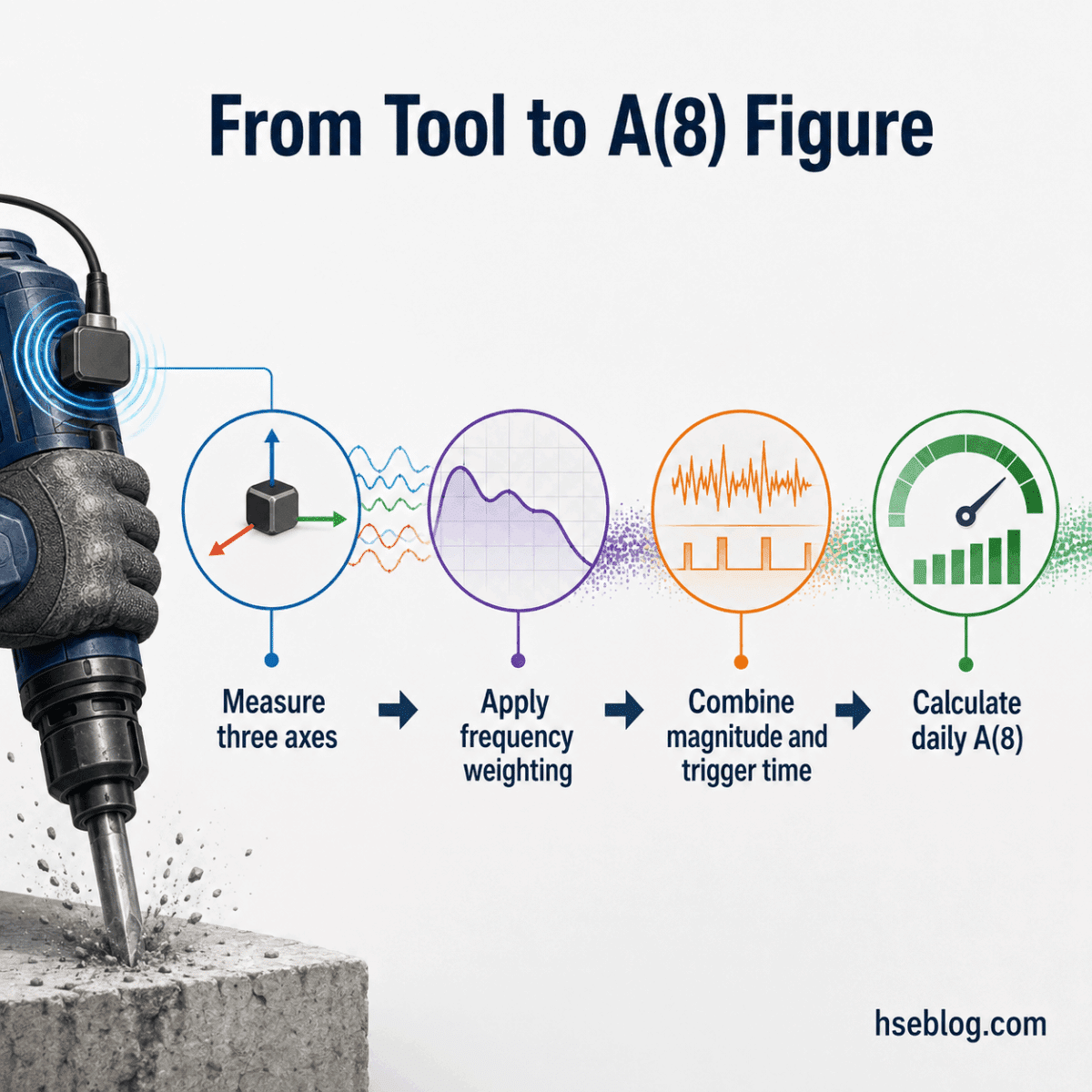
Vibration assessment normally considers movement in three directions. A suitable vibration instrument uses frequency weighting and combines the three measured axes to determine a vibration total value.
International measurement guidance, including ISO 5349, describes approaches for assessing human exposure to hand-transmitted vibration. A reading taken in only one direction may not represent the full vibration exposure.
Source: hseblog.com
Vibration Acceleration
The strength of vibration expressed in m/s². Higher measured values generally mean greater exposure intensity when other relevant factors are equal.
Frequency Weighting
A measurement adjustment that reflects differences in human response to vibration at different frequencies.
Three-Axis Measurement
Assessment of vibration in three perpendicular directions, normally combined into a total vibration value.
A(8)
A daily vibration exposure value normalized to an eight-hour reference period.
Which Power Tools Commonly Produce Hand-Arm Vibration?
Tools that strike, rotate, cut, grind, or break hard material can transmit vibration through their handles. Common examples include rotary hammers, demolition hammers, impact tools, grinders, and powered sanders.
The tool category alone cannot establish the actual risk. The accessory, material, grip force, maintenance condition, and time spent working all matter.
Two grinders may have different vibration values even when their motor power is similar. The same grinder may also produce different values when fitted with different wheels.
Hand-Arm Vibration Exposure Limits: USA Versus UK
The United States and the United Kingdom do not use identical rules for hand-arm vibration exposure. This difference matters when U.S. readers encounter European tool manuals or online vibration calculators.
OSHA’s technical guidance states that federal OSHA does not have specific vibration exposure standards. However, vibration is still a recognized occupational health hazard. Employers should assess risks and use suitable controls rather than treating the absence of a numerical limit as proof of safety.
The American Conference of Governmental Industrial Hygienists provides occupational vibration guidance, while NIOSH publishes research and prevention recommendations. These resources help support risk management but should not be described as federal OSHA exposure limits.
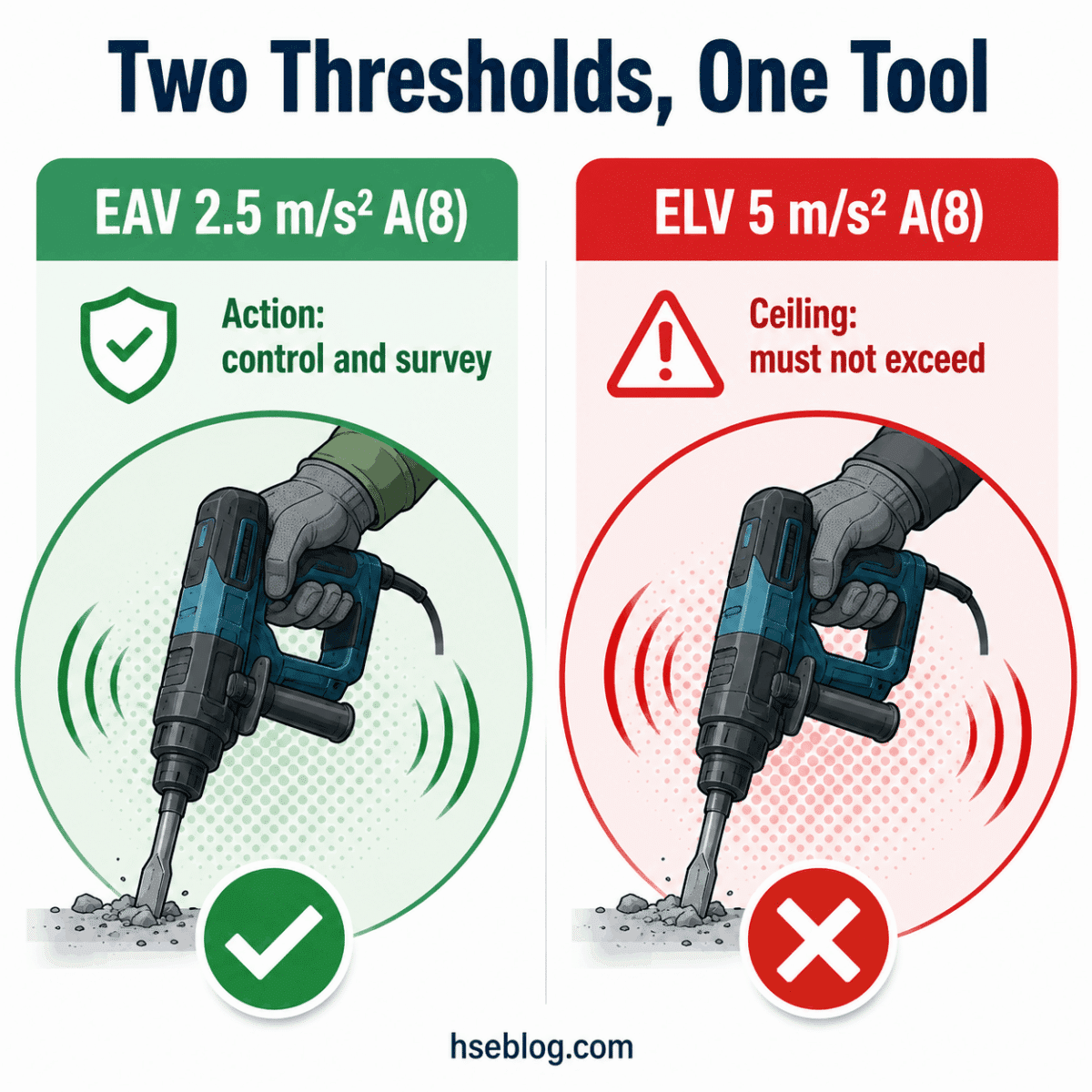
The UK’s Control of Vibration at Work Regulations use two key daily hand-arm vibration values. The exposure action value is 2.5 m/s² A(8), and the exposure limit value is 5 m/s² A(8). These values are based on a normalized daily exposure rather than a single instant of vibration.
At the action value, UK employers must take specified steps to control exposure. The limit value represents a level that must not be exceeded under those regulations. The figures are useful reference points for understanding vibration exposure, but they are not universal guarantees against injury.
Source: hseblog.com
Below 2.5 m/s² A(8)
Below the UK hand-arm vibration action value. Exposure may still carry risk, especially when repeated over many years.
2.5 m/s² A(8)
The UK exposure action value, or EAV, at which specified risk control duties apply.
5 m/s² A(8)
The UK exposure limit value, or ELV, which must not be exceeded under the applicable UK regulations.
United States
Federal OSHA has no equivalent universal numerical hand-arm vibration exposure standard. Applicable workplace obligations and recognized control practices still require attention.
Why an Action Value Is Not a Safe Versus Unsafe Boundary
A vibration action value is a trigger for preventive measures, not a line below which every worker is protected from harm. Individual susceptibility, past exposure, tool conditions, and total years of work can affect risk.
A person who uses vibrating tools for short periods each day may still build substantial long-term exposure. This is why prevention should begin before workers notice hand symptoms.
What Does the A(8) Rating Tell You?
A(8) expresses an eight-hour equivalent vibration exposure. It combines vibration intensity and actual contact time into a value that can be compared with daily exposure criteria.
It does not mean a tool must run for eight hours. A short period of strong vibration may create the same A(8) exposure as a longer period of lower vibration.
How to Calculate Daily Noise Exposure From Power Tools
Daily noise exposure is a combination of sound level and exposure time. It should include all relevant noise sources, not just the loudest tool.
A worker may use a saw for one part of a shift, a grinder for another part, and then remain near running equipment. Each period adds to the total exposure.
For a simple illustration, use the NIOSH recommended exposure time associated with each sound level. Divide the actual time at that sound level by its recommended duration, then add the fractions.
The result is an estimated fraction of the full daily recommended dose. It is an educational calculation, not a substitute for calibrated workplace measurements.
Step 1: Record Sound Levels
Measure or obtain representative sound levels in dBA at the worker’s listening position.
Step 2: Track Exposure Duration
Record the time the worker is exposed to each sound level. Include other machines and nearby work where relevant.
Step 3: Match Each Level to a Duration
Use the NIOSH 3 dB exchange-rate approach or an appropriate dosimeter configured for that criterion.
Step 4: Add the Exposure Fractions
Estimate the daily dose using the sum of actual time divided by recommended time for each exposure period.
Step 5: Review the Result
A dose near or above 100% of the NIOSH recommendation calls for stronger exposure controls. Lower doses do not guarantee that every hazard has been eliminated.
Example: Estimating a Mixed Daily Noise Dose
Consider a hypothetical worker exposed to 94 dBA for 30 minutes and 85 dBA for two hours. Under the NIOSH recommendation, 94 dBA reaches the full daily dose in one hour, while 85 dBA reaches it in eight hours.
The first period adds 0.5 divided by 1, or 50% of the recommended daily dose. The second adds 2 divided by 8, or 25%. Together, they produce an estimated 75% noise dose.
This estimate assumes representative, steady sound levels and excludes any other exposure during the day. It should not be used to establish OSHA compliance because OSHA uses different exposure calculation rules.
When Is a Personal Noise Dosimeter Needed?
A personal dosimeter is especially useful when sound levels vary or a worker moves between noisy areas. It tracks accumulated exposure over time and helps identify the total daily noise dose.
A calibrated sound level meter can assess noise from a fixed tool or work area. For formal compliance decisions, employers should use measurement equipment and procedures suited to the applicable standard.
How to Calculate Daily Hand-Arm Vibration Exposure
Daily hand-arm vibration exposure can be estimated from representative vibration magnitudes and actual trigger time. Trigger time is the period when the vibrating tool is operating and transmitting vibration to the user’s hand.
For one tool, a common calculation is A(8) = a × sqrt(T / 8). Here, a is the representative frequency-weighted vibration total value in m/s², T is the exposure time in hours, and sqrt means square root.
The calculation uses an eight-hour reference period. It does not assume the tool runs for the full shift, and it should not include breaks when the person is not exposed to that vibration source.
When several tools are used in one day, their contributions must be combined by adding the squared vibration values multiplied by their respective exposure times before taking the square root.
Source: hseblog.com
Record the Tool
Identify the exact tool, accessory, task, and working material.
Find Representative Vibration Data
Use appropriate workplace measurements, reliable task data, or manufacturer information verified as suitable for the work.
Track Actual Trigger Time
Record the period when each tool is transmitting vibration to the operator, rather than total time spent on the job.
Calculate Daily Exposure
For multiple tools, use A(8) = sqrt((a1² × T1 + a2² × T2 + …) / 8), with time in hours.
Compare With Applicable Guidance
Use the result to review risk, plan controls, and compare with the correct occupational guidance for the jurisdiction.
Example: One Tool Used for Two Hours
Assume a tool produces a representative vibration magnitude of 6 m/s² and is used for two hours of actual trigger time.
The calculation is A(8) = 6 × sqrt(2 / 8). The result is 3 m/s² A(8).
This hypothetical exposure exceeds the UK action value of 2.5 m/s² A(8) but remains below the UK limit value of 5 m/s² A(8). It does not prove the work is risk-free, and those UK thresholds are not U.S. legal limits.
Example: Two Vibrating Tools Used in One Shift
Assume a worker uses a first tool with a representative vibration magnitude of 6 m/s² for two hours. A second tool produces 4 m/s² for one hour.
The combined calculation is A(8) = sqrt((6² × 2 + 4² × 1) / 8). This gives sqrt(11), or about 3.32 m/s² A(8).
The exposures are not combined by simply adding the two vibration magnitudes or averaging them. The calculation accounts for the squared magnitude of each source and the time spent using it.
If the vibration values do not represent actual working conditions, the result may be misleading. A qualified occupational hygienist can help resolve uncertain data or complex exposure patterns.
How to Measure Noise and Vibration in Real Working Conditions
Reliable exposure assessment starts with a clear record of the task. Note the tool model, accessory, material, work method, operator position, and the time spent using the equipment.
Noise and vibration require different instruments. A sound level meter or personal dosimeter is used for noise. A suitable vibration measurement system uses sensors to record the acceleration transmitted through the contact surface.
Not every reading from a mobile app or inexpensive meter is accurate enough for occupational compliance work. Instrument calibration, sensor position, frequency weighting, and measurement method can all affect the result.
Check Equipment Conditions
Inspect accessories, worn parts, bearings, handles, and other components before measuring. A damaged tool may behave differently from a maintained tool.
Use Representative Tasks
Measure the work as it is normally performed. A no-load test may not reflect cutting, drilling, grinding, or demolition work.
Record Exposure Time
Track each noise period and each vibrating tool’s actual trigger time separately.
Review Measurement Quality
Check calibration, operating settings, uncertainty, sensor placement, and whether conditions match the intended exposure assessment.
Reassess After Changes
Repeat the assessment if new tools, materials, tasks, or operating methods could increase exposure.
Signs That the Assessment May Be Incomplete
A single tool specification should not be used as the sole basis for a full workplace exposure assessment. The result may miss other equipment, reflected noise, changes in workload, and actual contact time.
Warning signs include measurements taken at the wrong location, readings recorded with unknown instrument settings, or exposure estimates based only on the length of the work shift.
If the data are uncertain, use conservative controls while arranging a more suitable assessment. Do not assume a low displayed number means the hazard has been removed.
Practical Ways to Reduce Tool Noise Exposure
The strongest approach is to reduce noise at its source before relying on hearing protection. This is consistent with established occupational noise control principles.
A quieter tool, enclosure, work method, or accessory can lower the noise reaching the operator and nearby workers. Good tool maintenance also helps prevent excess noise caused by loose or damaged components.
For many tasks, engineering controls are more reliable than expecting workers to depend entirely on personal protective equipment. However, hearing protection remains important when noise cannot be adequately reduced by other means.
Choose Quieter Equipment
Compare sound ratings measured under similar conditions and consider the time required to finish each task.
Maintain Tools
Replace worn bearings, damaged blades, and faulty accessories according to the manufacturer’s instructions.
Control the Work Area
Use suitable acoustic barriers, enclosures, or isolation where practical and safe.
Reduce Unneeded Exposure
Keep nonessential workers away from noisy operations and avoid running equipment when it is not needed.
Use Appropriate Hearing Protection
Select suitable earplugs or earmuffs, make sure they fit, and use them throughout hazardous exposure.
How Much Protection Do Earplugs and Earmuffs Provide?
Hearing protectors have a labeled Noise Reduction Rating, or NRR. This is based on laboratory testing and does not guarantee the amount of protection a person receives in real use.
NIOSH’s updated guidance recommends individual quantitative fit testing to check the actual attenuation achieved by each worker. A Personal Attenuation Rating from fit testing is more useful than assuming everyone receives the full labeled NRR.
For noise exposure at 100 dBA or greater, or for impulse noise, NIOSH advises double protection with earplugs and earmuffs. Fit, comfort, communication needs, and worker training still matter.
Hearing protection should not be used as an excuse to leave avoidable noise sources unchanged. The goal is to lower total exposure while keeping workers able to recognize important warnings.
Practical Ways to Reduce Hand-Arm Vibration Exposure
Reducing hand-arm vibration begins with the task itself. If the job can be done without a vibrating hand tool, that may eliminate the exposure.
Where vibrating tools are necessary, select equipment and accessories that limit vibration while still completing the task effectively. Good maintenance is essential because worn or poorly balanced parts may increase vibration.
Reducing actual trigger time can also lower daily exposure. Job rotation can help spread exposure between workers, but it must be planned so that no worker simply receives a different harmful dose.
Tool design, workpiece support, operator technique, and grip force affect the vibration transmitted to the hands. Operators should follow the manufacturer’s instructions and maintain enough grip for safe control without using needless force.
Source: hseblog.com
Use Lower-Vibration Methods
Consider alternative processes, supported equipment, or mechanized methods that reduce direct hand contact with vibration.
Select Suitable Tools
Compare representative vibration data and choose equipment that can complete the task with less overall exposure.
Keep Accessories in Good Condition
Replace worn cutting wheels, damaged bits, unbalanced discs, and other faulty parts.
Control Trigger Time
Record active use, reduce unneeded operation, and divide tasks into practical work periods.
Support the Workpiece
Use clamps, stands, and suitable work supports to reduce needless force while maintaining safe tool control.
Keep Hands Warm and Dry
Suitable clothing and gloves can help reduce cold-related effects, but gloves should not be assumed to provide reliable protection against vibration.
Do Anti-Vibration Gloves Make Vibrating Tools Safe?
Anti-vibration gloves should not be treated as a complete control for hand-arm vibration. Their effectiveness varies with vibration frequency, glove design, tool type, and working conditions.
UK HSE guidance explains that gloves do not provide effective general protection from vibration from hand-held tools. NIOSH also warns against relying on gloves alone to control vibration transmitted to the hands.
Gloves may still help keep hands warm and dry, provided they are suitable for the task. They must not create entanglement hazards near rotating machinery.
Why Shorter Exposure Is Not the Only Solution
Shorter trigger time reduces daily vibration exposure when vibration magnitude remains the same. Yet a brief period with a very high vibration level can still contribute heavily to the daily dose.
Reducing vibration intensity and reducing exposure time together is usually more useful than relying on breaks alone. Planned rest periods should form part of a wider exposure control program.
Common Mistakes When Comparing Noise and Vibration Ratings
Many exposure mistakes come from treating a product specification as a direct measure of health risk. A rating describes a defined measurement, while exposure describes what reaches the worker over time.
The numbers become useful only when the test conditions, units, operating time, and relevant standards are understood. These checks can prevent false comparisons and missed hazards.
Comparing Different Noise Quantities
A sound power rating should not be compared directly with a sound pressure rating, even when both are presented in decibels.
Ignoring Exposure Duration
A tool’s rated dBA or m/s² value does not state how much exposure a worker accumulates during a shift.
Treating OSHA and NIOSH Limits as Identical
OSHA’s enforceable general industry noise requirements and NIOSH’s recommended occupational noise limits use different exposure criteria.
Applying UK Vibration Limits as US Law
The UK’s 2.5 and 5 m/s² A(8) values are not federal OSHA hand-arm vibration limits.
Ignoring Other Noise Sources
Daily noise dose may include nearby tools, machinery, vehicles, and other sources beyond the tool being assessed.
Using Shift Length Instead of Trigger Time
For hand-arm vibration, the relevant duration is actual exposure while vibration is transmitted, not simply total hours at work.
Trusting Protective Equipment Without Checking Fit
A high earplug NRR does not guarantee equivalent noise reduction at the ear. Gloves do not make vibrating tools harmless.
Ignoring Measurement Uncertainty
Declared ratings and workplace measurements carry uncertainty. Small differences between tools may not prove a meaningful exposure difference.
Can a Tool Meet a Standard and Still Cause Harm?
Yes. A product can satisfy applicable equipment requirements while still producing hazardous noise or vibration during use.
A safety standard for tool construction or testing is not the same as a guarantee that all tasks are safe. Safe operation still requires suitable work methods, exposure controls, maintenance, and proper assessment.
When to Stop Work and Seek Professional Help
Certain symptoms and work conditions deserve prompt attention. Hearing damage and vibration-related disorders may develop over time, and early signs should not be ignored.
If a worker has persistent ringing in the ears, muffled hearing, or difficulty hearing speech after noisy work, the exposure should be reviewed. A qualified hearing care professional or occupational health provider can assess the symptoms.
For vibration exposure, warning signs include repeated tingling, numbness, loss of finger control, unusual cold sensitivity, or fingers turning white. These symptoms may have causes other than tool vibration and require proper medical evaluation.
Sudden hearing loss needs urgent medical assessment. Do not wait for a routine workplace hearing test if hearing drops abruptly.
Stop and Review the Task
Suspend the suspected exposure when a serious hazard, unsafe equipment condition, or concerning symptom appears.
Report Workplace Symptoms
Notify the employer or safety representative and request the appropriate exposure review.
Arrange Qualified Assessment
Use occupational health professionals, audiologists, or qualified industrial hygienists as appropriate.
Correct the Exposure Source
Review equipment, maintenance, work practices, measured exposure, and the suitability of existing controls.
Document and Follow Up
Keep appropriate exposure and health records within the workplace safety program and reassess after corrective action.
How to Choose Tools With Lower Noise and Vibration Risk
A safer tool choice is based on the full task rather than one advertised number. Compare equipment that can do the required job, then assess its declared noise and vibration levels under equivalent test conditions.
Look for the stated measurement method, uncertainty, intended accessories, and any warnings about operating conditions. Ask the supplier for representative working data if the listed value does not match the planned application.
A tool that performs the task efficiently with lower measured exposure may offer a practical benefit. Yet a low-emission rating is not useful if poor tool performance makes the task much longer or creates another hazard.
The best decision also includes maintenance needs, replacement parts, suitable hearing protection, and the ability to monitor worker exposure during routine use.
Source: hseblog.com
Before Buying
Compare equivalent noise and vibration ratings, test conditions, the required accessories, and the expected time to complete the work.
Before First Use
Inspect the equipment, review the instructions, prepare the work area, and establish suitable exposure controls.
During Use
Track noise exposure and vibration trigger time, watch for changing tool behavior, and make sure workers use required protection.
After Work
Record meaningful exposure information, inspect tools, and address unusual noise, wear, or vibration.
When Replacing Equipment
Review whether a new tool or process can reduce actual daily exposure, not just the value printed in a product listing.
What If the Tool Has No Published Vibration Rating?
Do not assume an unlisted vibration value is zero or safe. Check the manufacturer’s complete manual and ask the supplier for representative vibration information.
If reliable data are unavailable, use suitable exposure controls and consider professional assessment. Avoid assigning a made-up vibration rating based only on tool size, voltage, or motor power.
Frequently Asked Questions
Q
What Noise Level Is Too Loud for Power Tools?
Repeated occupational noise exposure at or above 85 dBA is considered hazardous under NIOSH guidance. The duration of exposure also matters. A tool running at 100 dBA can reach the full NIOSH recommended daily dose in about 15 minutes.
OSHA’s legal exposure criteria differ from NIOSH recommendations. Workplace decisions should follow applicable requirements while aiming to reduce unnecessary noise.
Q
What Is a Safe Vibration Level for a Handheld Power Tool?
There is no single vibration magnitude that guarantees safety for every person and task. Daily exposure depends on vibration intensity, actual trigger time, and working conditions.
The UK uses 2.5 m/s² A(8) as an action value and 5 m/s² A(8) as a limit value for hand-arm vibration. These are useful assessment benchmarks but are not federal OSHA limits or guarantees of zero risk.
Q
Can I Use a Phone App to Measure Tool Noise?
A suitable phone app may help identify noisy areas and prompt a closer assessment. NIOSH offers a sound level meter app for supported iOS devices.
Phone measurements may not meet the accuracy and calibration requirements for legal workplace exposure assessment. Use appropriate professional instruments and procedures when accurate compliance measurements are required.
Q
Does Wearing Hearing Protection Increase Safe Tool Use Time?
Properly fitted hearing protection can reduce the noise reaching the ear. The actual benefit depends on the type of protector, fit, and consistent use.
However, the labeled NRR should not be subtracted directly from the measured dBA level as a guaranteed real-world result. Employer noise programs must also follow applicable OSHA rules for evaluating exposure and protection.
Q
Can Low-Vibration Tools Still Cause Hand-Arm Vibration Syndrome?
Yes. Lower vibration can reduce exposure, but it cannot guarantee that hand-arm vibration syndrome will never develop. Repeated use, long-term exposure, working conditions, and individual factors still affect risk.
Choose lower-vibration equipment when it is effective for the task. Combine it with good maintenance, exposure tracking, suitable work methods, and prompt assessment of symptoms.
✦ Wrapping Up
Conclusion
Tool noise ratings and vibration ratings are useful only when they are read in context. A noise figure in dBA describes sound under stated conditions, while a vibration figure in m/s² describes the intensity of vibration. Neither number alone establishes the daily health risk.
For U.S. workplaces, OSHA’s applicable noise standards define legal duties, while NIOSH recommendations support more protective hearing conservation practices. Federal OSHA has no single numerical hand-arm vibration exposure limit, but vibration-related injury remains a real occupational hazard.
The practical goal is to reduce exposure before damage occurs. Use suitable tools, maintain them well, measure representative working conditions, record time spent exposed, and apply effective controls. Seek qualified help when exposure data are uncertain or workers report hearing or hand symptoms.
Good safety decisions do not depend on finding one perfect rating. They depend on understanding the task, the measured hazard, the exposure period, and the controls that can reduce risk.
💡 Key Takeaway
Before the next noisy or vibrating job, check the tool’s ratings, record likely exposure time, and review the work method. Use appropriate hearing protection and practical vibration controls, and arrange a qualified assessment when the risk cannot be reliably estimated.
Compare oscillating tool vs reciprocating saw to pick the right cutter for your project—speed, precision, and blade choices explained to help you decide fast.