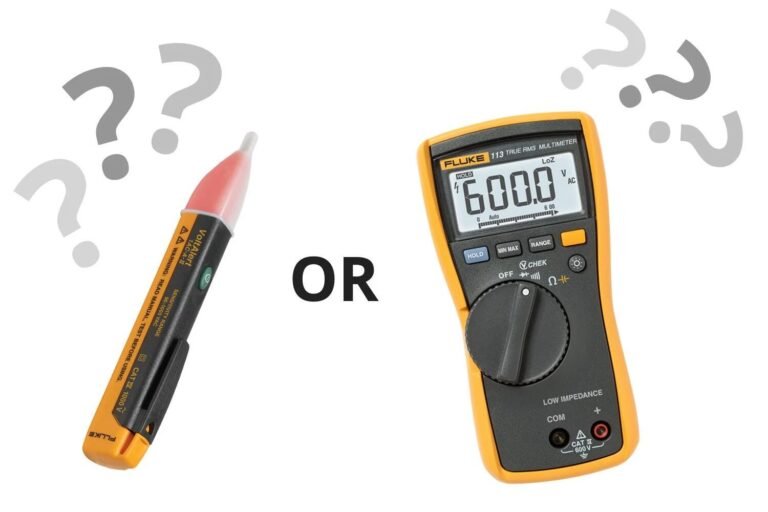
A receptacle tester checks outlet wiring fast, while a voltage detector helps find live power without contact.
If you work around home wiring, these two tools can save time and prevent mistakes. I’ve used both in real jobs, and the difference matters more than most people think. A receptacle tester vs voltage detector comparison is not just about tools, but about choosing the right one for safety, speed, and the task in front of you.

What a receptacle tester does
A receptacle tester is a small plug in device that checks the wiring inside a wall outlet. It is usually used on standard 120 volt receptacles in homes and light commercial spaces. When you plug it in, it can show common wiring problems like an open ground, open neutral, or reversed hot and neutral.
This tool is simple, but it is very useful. I have seen it catch bad outlets in brand new-looking homes where the wiring had been done wrong behind the wall. That is the tricky part with electricity: an outlet can look fine and still be unsafe.
A receptacle tester is best when you want to verify outlet wiring quickly. It gives you a direct check of the receptacle itself, not just whether something nearby has power.
What a voltage detector does
A voltage detector is used to sense electrical voltage, often without touching the wire directly. Many people use non contact voltage detectors to check whether a wire, switch, or outlet may be live. Some models also come as contact testers or multimeters, but the common handheld tool most people mean is the non contact type.
This tool is great for quick safety checks. Before opening a box or removing a switch plate, I often use a voltage detector first. It is like a smoke alarm for live power: it does not tell you everything, but it can warn you fast.
A voltage detector is best when your main goal is to see whether voltage is present. It is not designed to diagnose every wiring problem inside a receptacle.
Receptacle tester vs voltage detector: the core difference
The simplest way to think about receptacle tester vs voltage detector is this: one checks wiring quality, the other checks for live electricity. A receptacle tester plugs into the outlet and reads how the outlet is wired. A voltage detector senses voltage and helps confirm whether a conductor may be energized.
Here is the practical difference:
• Receptacle tester: best for outlet diagnostics
• Voltage detector: best for quick live power checks
• Receptacle tester: gives clearer wiring fault clues
• Voltage detector: helps with safer first checks before touching anything
• Receptacle tester: works only on receptacles it can plug into
• Voltage detector: can often be used on switches, cords, and breaker areas
In real work, these tools often complement each other. I rarely rely on only one when troubleshooting, because each fills a gap the other leaves open.

When to use a receptacle tester
Use a receptacle tester when you want to check the health of an outlet. It is especially helpful if you are dealing with a loose plug, a dead outlet, or a new installation. It can also help confirm whether a GFCI outlet is wired and functioning correctly, depending on the tester type.
Common uses include:
• Checking a new outlet after installation
• Confirming power and wiring before using appliances
• Finding open ground or reversed polarity
• Troubleshooting a dead receptacle
• Verifying basic outlet safety in older homes
One mistake I made early on was assuming a power strip problem was really a bad outlet. A receptacle tester showed the outlet was wired fine, which saved me time and kept me from chasing the wrong issue. That is one reason this tool belongs in almost every basic electrical kit.
When to use a voltage detector
Use a voltage detector when you need to know if something may still be live. It is useful before changing a light switch, opening a junction box, or checking a cord. Because it does not need direct metal contact in many cases, it can make the first step faster and safer.
Typical uses include:
• Checking if a wire is energized before work begins
• Testing outlets, switches, and cords for voltage presence
• Helping confirm a breaker shutoff before touching wiring
• Finding a hot wire in a bundle during troubleshooting
• Doing quick safety checks in tight spaces
Still, a voltage detector has limits. It may give false positives from induced voltage, and some models can miss weak or poorly grounded conditions. That is why I never treat it as the final word when safety is on the line.
Receptacle tester vs voltage detector for safety
Safety is where receptacle tester vs voltage detector becomes a real decision, not just a tool preference. A voltage detector helps reduce risk before direct contact. A receptacle tester helps reveal hidden outlet problems after power is confirmed safe.
The safest habit is to use both in the right order:
- Use a voltage detector to see whether voltage may be present.
- Turn off the circuit if needed.
- Use a receptacle tester to confirm outlet wiring after power is restored for testing, or when appropriate for the task.
- If something looks odd, verify with a multimeter or call a licensed electrician.
That layered approach is how professionals avoid surprises. It is not about trusting one gadget too much. It is about using the right tool at the right step.
Accuracy, limits, and common mistakes
Neither tool is perfect. That is the part many beginners miss when comparing receptacle tester vs voltage detector. A receptacle tester can show basic wiring faults, but it cannot tell you everything about voltage quality, load issues, or every hidden problem. A voltage detector can warn you about live power, but it cannot confirm proper wiring or polarity on its own.
Common mistakes include:
• Using a non contact voltage detector as the only proof that a circuit is dead
• Assuming a receptacle tester can diagnose all outlet problems
• Ignoring loose connections behind the wall
• Trusting old or low quality tools without checking their batteries
• Forgetting that GFCI and AFCI issues may need more than a basic tester
From experience, one of the biggest traps is overconfidence. Tools are helpers, not magic wands. If a reading does not make sense, stop and verify with a more complete test method.
Which tool should you buy first
If you only want one tool first, choose based on your main task. For basic home safety and outlet checks, a receptacle tester is a smart first buy. For quick live wire checks and safer first steps before opening electrical boxes, a voltage detector is often the better first choice.
A simple buying guide:
• Homeowners checking outlets often: start with a receptacle tester
• DIYers opening switches and fixtures: start with a voltage detector
• People doing both: buy both, because they solve different problems
• Anyone doing deeper troubleshooting: add a multimeter later
If I were setting up a basic tool bag for a new homeowner, I would buy both over time. The pair covers more ground than either one alone, and that makes everyday electrical work smoother and safer.

How these tools fit into real home projects
In real home use, receptacle tester vs voltage detector is not an either or decision. It is more like using a flashlight and a map. One shows what is nearby, and the other tells you where to go.
Here are a few real life examples:
• Replacing an outlet: use a voltage detector first, then a receptacle tester after the work is done
• Troubleshooting a dead lamp: use a voltage detector to check the outlet and cord
• Checking an older home: use a receptacle tester to spot miswired receptacles
• Swapping a switch: use a voltage detector before removing the cover plate
That workflow saves time and helps avoid repeat trips. I have learned that the best electrical repairs usually come from calm, step by step checking, not guesswork.
Best practices for using both tools
A good result starts with good habits. These tools are simple, but the way you use them matters.
• Always check the tool condition before use
• Replace batteries when readings seem weak or inconsistent
• Read the tool’s instructions for proper use and limits
• Treat every reading as one clue, not the whole story
• When in doubt, confirm with a multimeter or professional help
Also, remember that electrical work carries risk. The National Electrical Code and general safety guidance from electrical safety organizations stress proper testing, circuit isolation, and caution around live conductors. That is why even basic tools should be used with respect.
Receptacle tester vs voltage detector: which is better for beginners
For beginners, neither is “better” in every case. A receptacle tester is easier to understand if your goal is checking outlets. A voltage detector is easier to use if you want a fast yes or no sense of whether something may be live.
If you are new to DIY electrical work, start here:
• Learn what each tool can and cannot do
• Practice on a known working outlet or cord
• Do not assume silence or no beep means complete safety
• Build the habit of double checking before touching wiring
That learning curve is worth it. The more you understand the tools, the less likely you are to make a dangerous assumption.
Frequently Asked Questions of receptacle tester vs voltage detector
Can a voltage detector replace a receptacle tester?
No, a voltage detector cannot fully replace a receptacle tester. It can tell you if voltage may be present, but it cannot reliably diagnose open ground, reversed polarity, or other outlet wiring faults.
Is a receptacle tester safe to use for beginners?
Yes, a receptacle tester is generally beginner friendly when used on standard outlets. It is simple to plug in and read, but you still need to understand what the lights or display mean.
Why does my voltage detector beep near an outlet even when power is off?
Non contact voltage detectors can sometimes react to induced voltage, nearby energized wires, or tool sensitivity. That is why they should be used as a first check, not the only proof that a circuit is safe.
Can a receptacle tester check GFCI outlets?
Yes, many receptacle testers can check GFCI operation on outlets that support that feature. The exact result depends on the tester model and how the circuit is wired, so always follow the tester instructions.
Which tool is better for finding a hidden live wire?
A voltage detector is usually better for finding whether a wire may be live without direct contact. It is faster for preliminary checks, but you may still need a multimeter or professional diagnosis for certainty.
Conclusion
When you compare receptacle tester vs voltage detector, the answer is not about picking a winner. It is about using the right tool for the job. A receptacle tester helps you understand outlet wiring, while a voltage detector helps you quickly spot possible live power.
If you want safer, smarter electrical work, keep both tools in mind and use them together when needed. Start small, test carefully, and never rush around electricity. If this guide helped, explore more home safety resources, save the article for later, or leave a comment with your own testing tips.

Mick Thomas
Contributor