Digital manifolds give faster, smarter readings, while analog manifolds offer simple, durable hands-on control.
If you work with HVAC, refrigeration, or automotive systems, the digital manifold vs analog manifold choice can affect speed, accuracy, and how confidently you work in the field. I’ve seen both types do their job well, but each shines in a different kind of workflow. In this guide, I’ll break down the digital manifold vs analog manifold comparison in plain English so you can choose the one that fits your tools, your budget, and your real-world service needs.
What is a manifold gauge set?
A manifold gauge set is a tool used to measure pressure in a refrigeration or air conditioning system. It helps technicians check the low side and high side of the system, which is key for diagnosing performance problems.
In simple terms, it is like a window into the system. You can see whether the pressure levels look normal, too high, or too low. That makes the manifold gauge set one of the most useful tools in HVAC and refrigeration work.
There are two common types: digital manifold and analog manifold. Both do the same basic job, but they handle the reading process in very different ways.
Digital manifold vs analog manifold: the core difference
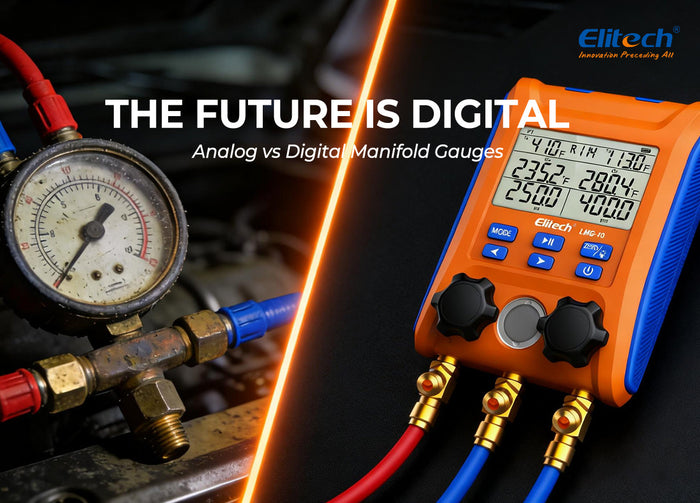
The main difference in the digital manifold vs analog manifold comparison is how the data is shown. A digital manifold uses electronic sensors and a screen to display readings. An analog manifold uses mechanical gauges with needles and dials.
That difference changes the whole experience. Digital models often give more features, like temperature readings, superheat, subcooling, data logging, and sometimes wireless connection. Analog models keep things simple and usually rely on the technician’s skill to interpret the readings.
In my experience, the digital manifold feels like a smart assistant. The analog manifold feels like a trusted old wrench: plain, solid, and always ready.
How a digital manifold works
A digital manifold uses sensors to collect pressure data from the system. The unit then converts that data into numbers on a display. Many models also include temperature clamps, built-in refrigerant libraries, and automatic calculations.
This can save time in the field. Instead of doing every calculation by hand, you can get more of the information in one place. That is especially helpful when handling modern systems with tighter performance limits.
Common features of a digital manifold include:
• Pressure readings in real time
• Temperature measurement with probes or clamps
• Superheat and subcooling calculations
• Vacuum measurement on some models
• Bluetooth or app-based reporting on premium models
How an analog manifold works
An analog manifold uses mechanical gauges and hoses to show pressure. The needle moves based on the pressure inside the system. Technicians read the dial and compare it with system charts or experience.
This setup is easy to understand and does not depend on batteries or software. For many technicians, that simplicity is a major advantage. If the gauge is in good condition, it can work for years with very little trouble.
Common parts of an analog manifold include:
• Low-pressure gauge
• High-pressure gauge
• Manifold body with control valves
• Hoses
• Service ports
Digital manifold vs analog manifold: accuracy and readability
When people compare digital manifold vs analog manifold, accuracy is usually the first topic that comes up. Digital units tend to be easier to read because they show exact numbers, often down to a tenth or hundredth depending on the model.
That said, accuracy depends on quality, calibration, and maintenance. A cheap digital unit can be less reliable than a well-made analog gauge. On the other hand, analog readings can be harder to interpret because the needle position may sit between marks or move slightly during use.
If you have ever tried to read a small needle while kneeling beside a noisy condenser, you know the problem. The digital display is easier on the eyes. But the analog gauge still has one big strength: there is no screen lag, menu, or battery issue to fight with.
Which one is better for HVAC work?
The answer depends on the job. For modern HVAC service, a digital manifold is often the better choice when speed and detail matter. For basic service, routine checks, or backup use, an analog manifold can still be an excellent tool.
Here is a practical way to think about it:
• Choose digital if you want fast calculations and clear readings
• Choose analog if you want low cost and simple operation
• Choose digital if you work on complex systems often
• Choose analog if you need a rugged spare or entry-level option
I’ve seen newer techs move faster with digital tools because the readings are easier to understand. But I’ve also seen experienced techs keep an analog set in the truck because it is dependable and familiar.
Benefits of a digital manifold
A digital manifold can make fieldwork easier in several ways. It reduces manual math, improves reading clarity, and often gives more data in one tool.
Main benefits include:
• Faster diagnosis because calculations happen automatically
• Better readability in low light or tight spaces
• Fewer mistakes when reading pressure values
• Useful advanced functions like superheat and subcooling
• Often better for documentation and reporting
This is one reason digital tools are common in modern service work. Industry training programs and manufacturer manuals often emphasize accurate system data, and digital manifolds help technicians get there more quickly.
Limitations of a digital manifold
A digital manifold is not perfect. It usually costs more than an analog model, and it depends on batteries or internal power. If the screen fails or the sensors drift, the unit can become frustrating fast.
Other limits include:
• Higher purchase price
• Battery dependence
• Possible software or sensor issues
• More delicate than a basic analog unit in some cases
From real experience, the biggest mistake is trusting the screen without checking the setup. If the sensors are not calibrated or the temperature clamp is loose, the result can look “precise” while still being wrong.
Benefits of an analog manifold
The analog manifold still has a loyal following for good reasons. It is simple, durable, and usually more affordable. Many technicians like the direct feel of the gauges and valves.
Main benefits include:
• Lower cost
• No batteries needed
• Easy to use for basic pressure checks
• Often rugged and long-lasting
• Great as a backup tool in the field
For many service calls, basic pressure readings are all you need to start troubleshooting. An analog manifold handles that job well, and it does not ask much in return.
Limitations of an analog manifold
The biggest drawback is that analog readings take more skill to interpret. You often need to calculate superheat or subcooling by hand. That can slow things down and increase the chance of human error.
Other limitations include:
• Less precise visual display
• More manual math required
• Harder to record data quickly
• Can be harder to read in poor light
I have watched new technicians get tripped up by tiny gauge movements. The tool was not the issue. The issue was the learning curve.
Digital manifold vs analog manifold: cost comparison
Price is a major factor in the digital manifold vs analog manifold decision. Analog manifolds usually cost less upfront, which makes them attractive for beginners, apprentices, or backup kits.
Digital manifolds cost more, but they often replace several tools at once. If you use the extra features often, the higher price can be worth it. If you only need basic pressure checks, the simpler option may make more sense.
A good way to compare value is to ask:
• How often will I use the advanced features?
• Will the time saved justify the price?
• Do I need field reporting or data logging?
• Is this my main tool or a backup tool?
Digital manifold vs analog manifold: which is easier to learn?
For beginners, digital manifolds are often easier to read. The screen removes much of the guesswork. That can help new users focus on the system instead of spending time decoding the gauge face.
However, analog manifolds can teach fundamentals better. They force you to understand pressure relationships, needle movement, and system behavior. That knowledge can make you a stronger technician over time.
A lot of people learn both. That is usually the smartest path. Digital helps with speed, and analog helps with understanding.
Best use cases for digital manifolds
A digital manifold is a strong fit for:
• HVAC technicians who want faster diagnostics
• Commercial refrigeration work
• Jobs that require detailed measurements
• Technicians who document readings often
• Teams using modern service workflows
If you often move between jobs and need to stay quick, digital can feel like a real advantage. It is especially useful when precision and reporting matter.
Best use cases for analog manifolds
An analog manifold is a strong fit for:
• Budget-conscious buyers
• Apprentices learning the basics
• Emergency backup kits
• Routine pressure checks
• Technicians who prefer simple, durable tools
If you want a tool that is easy to grab and hard to break, analog is still a strong choice. It may not be flashy, but it gets the job done.
Digital manifold vs analog manifold in real-world service work
In the field, the best tool is often the one that fits the task and the technician. I have used digital manifold tools on busy service days when time mattered and the system needed careful tuning. I have also used analog gauges on quick maintenance calls where I only needed a pressure snapshot.
One lesson I learned early is not to confuse convenience with skill. A digital manifold can make work easier, but it cannot replace good diagnosis. Likewise, an analog manifold may seem old-school, but it can still tell you a lot if you know how to listen to the system.
If you are building a service kit, think about how you work:
• Fast-paced route work favors digital
• Simple maintenance favors analog
• Advanced troubleshooting often benefits from both
• Backup reliability argues for keeping analog on hand
How to choose between digital and analog
To choose between digital manifold vs analog manifold, start with your daily work. Do you need speed, accuracy, and automation? Or do you need a tough, low-cost tool that does the basics well?
Use this checklist:
- Set your budget
- Decide how often you need advanced measurements
- Think about battery dependence
- Consider how much calibration and care you want to manage
- Match the tool to your skill level and job type
If you are still unsure, many technicians start with analog and move to digital later. That path works well because it builds both practical skill and tool confidence.
Frequently Asked Questions
What is the main difference between a digital manifold and an analog manifold?
A digital manifold uses sensors and a screen to show readings, while an analog manifold uses needle gauges and dials. The digital version is usually easier to read and offers more features, while the analog version is simpler and often cheaper.
Is a digital manifold more accurate than an analog manifold?
Not always. A digital manifold can be easier to read and may reduce user error, but accuracy still depends on calibration and build quality. A high-quality analog manifold can also be very reliable if it is well maintained.
Which is better for beginners, digital manifold vs analog manifold?
Many beginners find a digital manifold easier because the readings are clear and automatic. Still, an analog manifold can help new users learn the basics of pressure behavior and system diagnosis.
Do digital manifolds need calibration?
Yes, they should be checked regularly to stay accurate. Like any measuring tool, a digital manifold can drift over time, especially if it gets rough field use or is not stored properly.
Can an analog manifold still be used on modern HVAC systems?
Yes, an analog manifold is still useful for many HVAC and refrigeration tasks. It may take more manual interpretation, but it can absolutely support diagnosis, charging, and pressure checks on modern systems.
Which one lasts longer, digital manifold vs analog manifold?
Analog manifolds often last longer in harsh conditions because they have fewer electronic parts. Digital manifolds can still last a long time, but they usually need more care because of batteries, screens, and sensors.
Conclusion
When you compare digital manifold vs analog manifold, the best choice comes down to how you work. Digital gives you speed, clear numbers, and helpful features. Analog gives you simplicity, durability, and lower cost.
If you want a tool that makes complex service easier, digital is often worth the investment. If you want a reliable, affordable tool that handles the basics, analog still earns its place. The smartest move is to choose the manifold that matches your real job, not just the one with the flashiest feature list.
Take a fresh look at your workflow, your budget, and the systems you service most. Then pick the tool that helps you work with more confidence and fewer mistakes. If this guide helped, keep exploring, compare models carefully, and leave a comment with the setup you trust most.

Mick Thomas
Contributor